
Lesson 4: Brainstorming is Collective Intelligence in Motion
- Patrick Sebastien
- May 5
- 7 min read

Updated: May 5

Brainstorming is often misunderstood.
For many teams, it means gathering people in a room, asking for ideas, writing a few things on a whiteboard, and hoping something useful emerges. Sometimes it does. Often, it doesn’t.
The problem isn’t that brainstorming is weak. The problem is that most brainstorming is unguided.
At its best, brainstorming isn’t random idea generation. It’s collective intelligence in motion — individual perspectives converging around one challenge, then expanding into better ideas, sharper clarity, and aligned action.
This definition matters because it changes the way we think about the process.
Brainstorming isn’t simply about producing more ideas. It’s about creating the conditions where a group can think better together than they could separately.
Research on group performance supports this idea. Studies on brainstorming have shown that unstructured group sessions can suffer from productivity loss, often because of production blocking, evaluation apprehension, and social loafing. In simple terms, people wait their turn, hold back ideas, or unconsciously let others carry the load.
That doesn't mean brainstorming does not work. It means brainstorming needs structure. And this is where the real opportunity begins.
1. Brainstorming Needs Structure
A group of intelligent people doesn’t automatically create an intelligent group.
This is one of the most important distinctions in team performance. We often assume that if we put smart people together, great ideas will naturally appear. But in practice, group thinking can become messy, cautious, repetitive, or dominated by a few voices.
This is why traditional brainstorming often underperforms. In unstructured sessions, people can lose ideas while waiting to speak. They may hesitate because they don’t want to sound wrong. They may unconsciously follow the opinion of the most senior person in the room. Or the conversation may move too quickly from idea generation into criticism and decision-making.
The result is a session that looks collaborative on the surface, but doesn’t fully leverage the intelligence in the room.
A better brainstorming process separates the stages.
First, the group needs to clearly define the challenge. Then it needs space to generate ideas without immediately judging them. Then it needs a process to organize, connect, refine, and prioritize those ideas. Without that structure, the team may create energy, but not necessarily clarity.
This is where facilitation becomes essential.
A guided brainstorming session creates rhythm. It gives the group a shared focal point. It protects the early creative phase from premature criticism. It makes room for quieter voices. It helps stronger personalities contribute without unconsciously dominating. It keeps the session moving from scattered thought toward useful output.
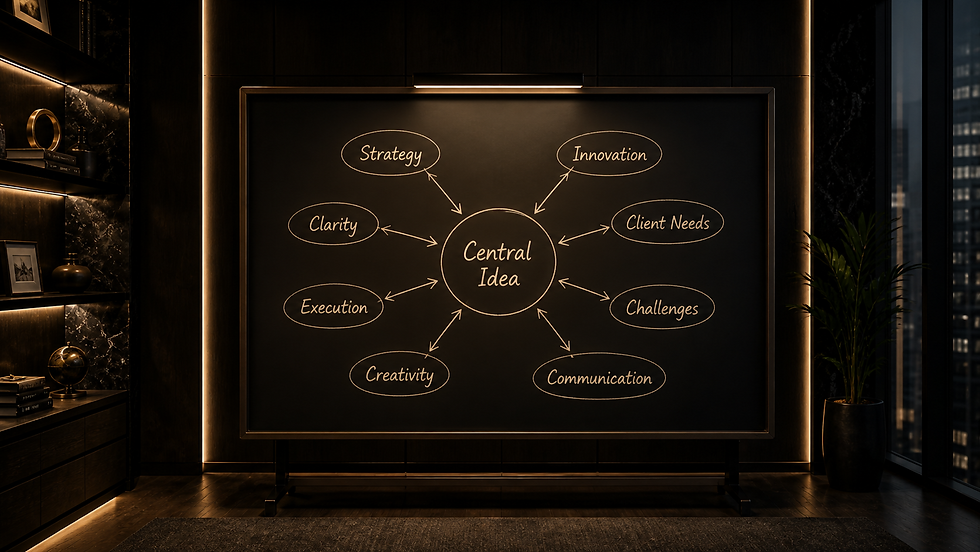
In the image, the circle at the center represents the shared challenge. The arrows represent the movement of ideas and attention. The process is not random. Everything moves toward the center, and everything expands back outward.
That is what structured brainstorming should do. It brings people into focus, activates their individual perspectives, and turns those perspectives into something the group can use.
2. Brainstorming Is Powered by Collective Intelligence
The most powerful argument for brainstorming isn’t that groups can create more ideas. It’s that the right group, under the right conditions, can produce a higher level of thinking.
This is the concept of collective intelligence.
A major study published in Science found evidence for a measurable collective intelligence factor in groups. The study showed that some groups consistently performed better across different tasks, but not simply because they had the smartest individual members. Group performance was linked more strongly to factors such as social sensitivity, balanced participation, and the quality of interaction between members.
That finding is important for business.
It suggests that the intelligence of a team isn’t only a collection of individual IQs, credentials, or technical skills. It’s also a property of the group system itself.
How well do people listen?
How evenly is participation distributed?
Can the group sense tension, confusion, hesitation, or opportunity?
Can members build on each other’s thoughts instead of competing for attention?
Can the team move as one intelligent organism rather than a collection of separate opinions?
This is where brainstorming becomes more than a creative exercise. It becomes a team performance practice.
When collective intelligence is activated, the room changes. Ideas don’t only come from one person. They move between people. One perspective opens another. One unfinished thought becomes useful when someone else adds context. A challenge that feels stuck begins to reveal new angles.
In that state, the group isn’t just exchanging ideas.
It’s thinking together.
This connects directly to the visual language of the image. Each person brings a line of attention toward the center. Each line also moves back outward. The center is not owned by one person. It belongs to the group. The better the connection between the individuals and the shared challenge, the stronger the collective output becomes.
True brainstorming isn’t a competition for the best idea, it’s the construction of a shared intelligence.
3. Brainstorming Requires Psychological Safety
For collective intelligence to emerge, people need more than a table, a challenge, and a process.
They need enough safety to think out loud.
Amy Edmondson’s research on psychological safety describes it as a shared belief that a team is safe for interpersonal risk-taking. In a work environment, this means people feel able to ask questions, admit uncertainty, challenge assumptions, and offer ideas without fear of embarrassment or punishment.
This is critical for brainstorming.
New ideas are rarely fully formed when they first appear. They are often rough, incomplete, awkward, or vulnerable. If the room feels judgmental, rushed, political, or tense, people will naturally protect themselves. They’ll edit their thoughts. They’ll say what feels acceptable. They’ll avoid ideas that may sound too bold, too simple, too strange, or too risky.
The cost is invisible but significant.
The group may never hear the idea that could have changed the conversation.
Psychological safety doesn’t mean lowering standards. It doesn’t mean every idea is good. It doesn’t mean the team avoids challenges or difficult discussions. It means creating the conditions where ideas can surface before they are evaluated.
This distinction is essential. High-performing teams don’t avoid pressure. They learn how to hold pressure without becoming defensive, closed, or reactive. This is where how you approach the experience can have a unique advantage.
Breath training and nervous system regulation can help shift the state of the room before the thinking begins. When people are stressed, guarded, or distracted, their attention narrows. Their breathing changes. Their body prepares for protection more than exploration. But when the group slows down, breathes together, and enters a more regulated state, the quality of attention changes.
People become more present.
They listen better.
They react less.
They access a wider range of thinking.
This is not only wellness. It is performance preparation.
In a guided session, the breathing component isn’t separate from the brainstorming. It’s part of the method. It helps create the internal conditions required for better external collaboration.
The group doesn’t just walk into the room and start solving.
They first learn how to be present.
Why Guided Brainstorming Elevates the Experience
The real value of guided brainstorming is that it transforms a meeting into a performance environment.
Most teams already have ideas. They already have intelligence. They already have experience, perspective, and creative capacity. The issue is that these assets are often trapped behind stress, hierarchy, distraction, poor structure, or unclear communication.
A guided session helps unlock what is already there.
It gives the team a shared challenge, a structured process, a regulated state, and a clear path from open thinking to aligned action. It helps balance participation so the loudest voice doesn’t automatically shape the outcome. It creates enough safety for people to offer ideas before they are polished. It helps the group move through pressure without losing clarity.
This is why brainstorming shouldn’t be treated as a casual exercise.
Done poorly, it becomes another meeting. Done well, it becomes collective intelligence in motion.
The goal isn’t simply to fill a board with ideas. The goal is to help a team access better thinking together, turn individual perspectives into shared clarity, and leave the room with stronger alignment and more meaningful next steps.
That’s the power of a guided brainstorming experience.
It doesn’t just ask, “What ideas do we have?”
It asks, “What becomes possible when we create the right conditions for this team to think as one?”
Activate the Intelligence Already in the Room
Most teams don't need more opinions, more meetings, or another generic brainstorming session.
They need the right conditions to think clearly together.
A Guided Brainstorming Experience is designed to help your team slow down, regulate the room, focus on one meaningful challenge, and activate the collective intelligence already present in the group.
Through breath, structure, guided conversation, and strategic facilitation, your team will move from scattered thinking into shared clarity, stronger ideas, and aligned next steps.
If your team is facing an important challenge, decision, or opportunity, this session can help create the focused environment needed to move forward.
Book a Guided Brainstorming Experience and help your team think better together.
Patrick Sebastien is a performance specialist in Montreal, QC who guides startups and entrepreneurs to turn stress into power, pressure into focus, and unlock peak performance.
References & Further Reading
Osborn, A. F. — Applied ImaginationAlex Osborn popularized the original brainstorming method, including the importance of separating idea generation from judgment and encouraging a high quantity of ideas before evaluation.
Diehl, M., & Stroebe, W. — “Productivity Loss in Brainstorming Groups”This research helped explain why unstructured group brainstorming can underperform, identifying factors such as production blocking, evaluation apprehension, and free riding/social loafing.
Woolley, A. W., Chabris, C. F., Pentland, A., Hashmi, N., & Malone, T. W. — “Evidence for a Collective Intelligence Factor in the Performance of Human Groups”This Science study found evidence of a measurable collective intelligence factor in groups, linked to social sensitivity, balanced participation, and communication patterns rather than simply individual intelligence.
Riedl, C., Kim, Y. J., Gupta, P., Malone, T. W., & Woolley, A. W. — “Quantifying Collective Intelligence in Human Groups”A later review and synthesis on collective intelligence, useful for understanding how group intelligence can be measured and studied across different types of tasks.
Edmondson, A. C. — Psychological Safety and Team LearningAmy Edmondson’s work on psychological safety supports the idea that teams perform and learn better when people feel safe to speak up, ask questions, challenge assumptions, and take interpersonal risks.



Comments